A Return to the Earth
In 2026 Nia gave a series of four Webinars entitled, “A Return to the Earth” that highlights the need to go far beyond any transformation of contemporary culture. Instead, she suggests human beings must return to the genetic imperative of being Earth People once again.
Click on the image for any of the four modules that follow to go to the associated video. Other links are primarily to documents shared on a Google Drive.
MODULE ONE: A Return to the Earth: CULTURAL PERSPECTIVES
Module One defines culture and elaborates upon cultural perceptions. We are currently immersed in a culture that views human beings as separate from nature; we are the premiere species, and we have the right to dominate all other life forms. As we move toward being decolonized people, it is critical to be conscious of the cultural lens through which we see the world because how a person sees the world is how a person acts toward the world affecting ecological, social, and spiritual relationships.
RECORDING for Module 1: The worldwide web of belief and ritual, TED talk by Wade Davis
READING for Module 1: The worldwide web of belief and ritual (transcript and questions to ponder)
MODULE TWO: A Return to the Earth: SEEING WITH A NATIVE EYE
Module Two elaborates on the worldview and ceremonial practices of the Indigenous cultures in North America. For the Native People, the world was seen as being in constant motion and flux. Everything was animated and imbued with spirit, consisting of energy waves, and a myriad of interrelationships. For this reason, an individual sense of self was not distinct from the animacy of the living planet with its myriad voices reflective of the need for reciprocal relationships.
Nia’s description of her Sundance experience
READING for Module 2: Seeing with a native eye: how many sheep will it hold? by Barre Tolken (1976)
SLIDES for Module 2 [from the slides: video of Diné ceremony]
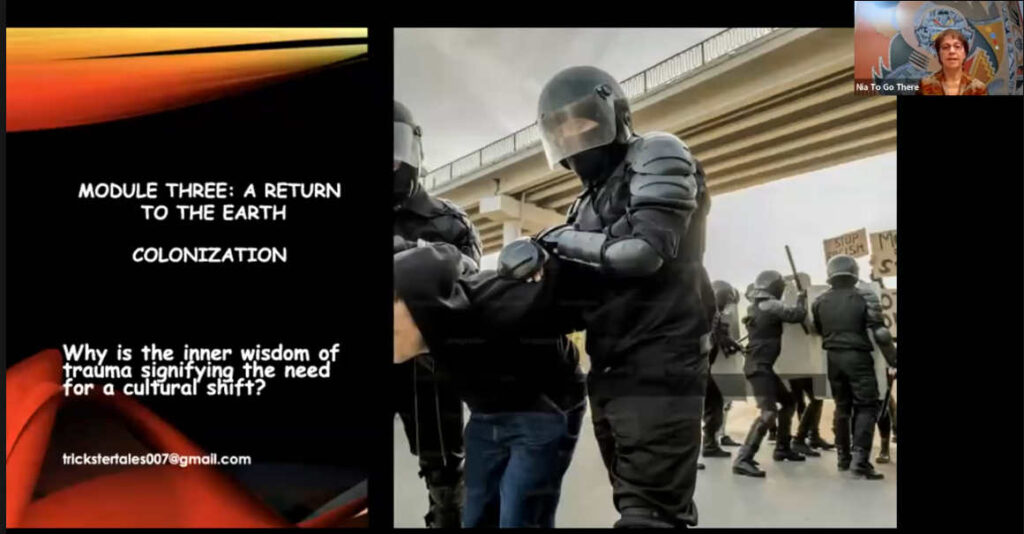
Module Three: A Return to the Earth: COLONIZATION
Module three focuses on colonization as cultural hegemony. Colonization was not a one-time event that happened to Indigenous People only, but it was a gradual process of shifting perspectives that emerged into a cultural worldview of hierarchical privilege where some human beings were dominant over other human beings and other life forms. Colonization and fascism share foundational similarities rooted in systems of hierarchy, exploitation, and violence, particularly concerning the concepts of race, territory, and authoritarian control.
READING for Module 3: Questions for reflections on … [PDF] The Absolutely True Diary of a Part-time Indian by Sherman Alexie (Book is readily available in Public Libraries and bookstores.)
Module Four: A Return to the Earth: DECOLONIZATION
Module four addresses DECOLONIZATION as a transformation back to a deep and profound sense of connection to our ancestral roots. If we consider the last 300,000 years, it is astonishing to learn that 94% of the time human beings viewed all of nature as sacred and interconnected. The People were immersed in the understanding that nothing is separate, that when we harm one aspect of the world out there, it affects all of us, so we ask, isn’t it time to return to our original “story?”
READING for Module 4: The Times They Are a Changin’ by Nia TGT