ECONOMICS: CAPITALISM TO THE POTLATCH

Economics is the mother tongue of public policy. It dominates our decision-making for the future, guides multi-billion-dollar investments, and shapes our responses to climate change, inequality, and other environmental and social challenges that define our times. Our present stance on Economics is the “bedrock” of colonial thinking that has led to a world where there is nothing but merchandise: humans, sold as workforce, and nature sold as resources.
In contrast, the Indigenous world was built on mutual giving and reciprocity with humans and other beings. Integral to decolonization is to make transformative and meaningful changes modeled after the Indigenous cultures. It requires systemic change.This transformative shift requires a move out of the present Capitalist Model that has enveloped the globe, catalyzing a dramatic increase in the consumption of natural resources. This consumption has begun to take its toll, raising concerns about massive extinction of species, a global freshwater crisis, and runaway climate change.
The books and videos listed below give practical ideas on how to make this paradigm shift collectively and individually as we transition from capitalism to the spirit of the Potlatch ceremony.
Sacred Economics | Money, Gift, and Society in the Age of Transition
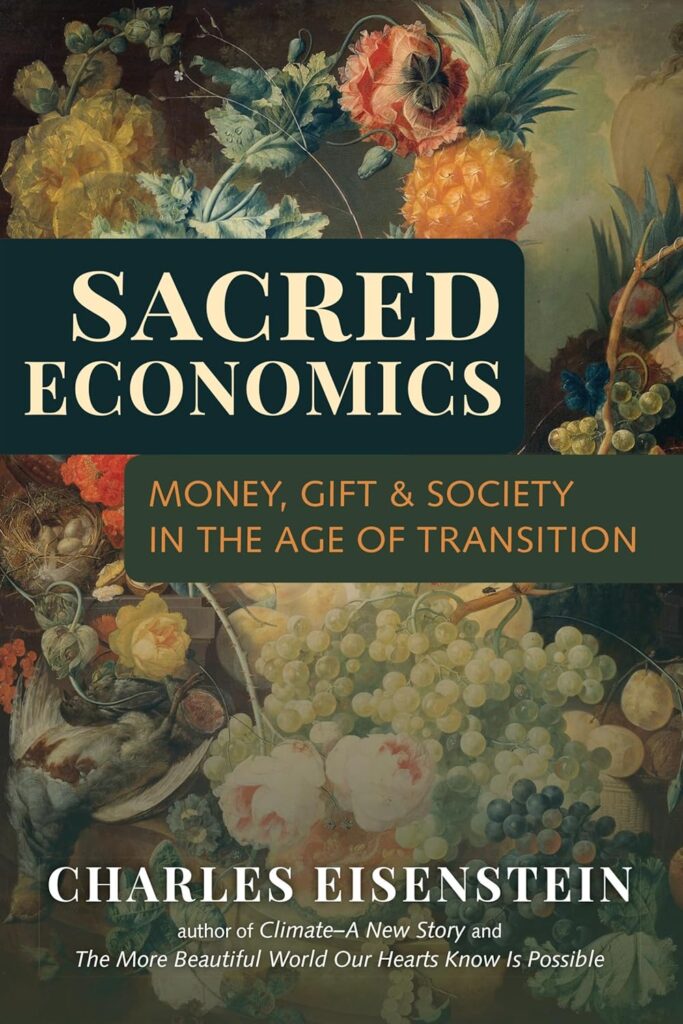
by Charles Eisenstein (2011)
Tapping into a rich lineage of conventional and unconventional economic thought, Sacred Economics presents a vision that is original yet commonsense,
radical yet gentle, and increasingly relevant as the crises of our civilization deepen. It traces the history of money from ancient gift economies to modern capitalism, revealing how the money system has contributed to alienation, competition, and scarcity, destroyed community, and necessitated endless growth. Today, these trends have reached their extreme—but in the wake of their collapse, we may find great opportunity to transition to a more connected, ecological, and sustainable way of being.
It underscores the importance of changing the present money system to embody an integrated synthesis of theory, policy, and practice, Sacred Economics explores avant-garde concepts of the New Economics, including negative-interest currencies, local currencies, resource-based economics, gift economies, and the restoration of the commons.
Doughnut Economics | Seven Ways to Think Like a 21st-Century Economist
by Kate Raworth, 2017.
Simple, playful, and eloquent, Doughnut Economics offers game-changing analysis and inspiration for a new generation of economic thinkers. The author sets out seven key ways to fundamentally reframe our understanding of what economics is and does. Along the way, she points out how we can break our addiction to growth; redesign money, finance, and business to be in service to people; and create economies that are regenerative and distributive by design.
Named after the now-iconic “doughnut” image that Raworth first drew to depict a sweet spot of human prosperity (an image that appealed to the Occupy Movement, the United Nations, eco-activists, and business leaders alike), Doughnut Economics offers a radically new compass for guiding global development, government policy, and corporate strategy, and sets new standards for what economic success looks like. She taps into the best emergent ideas – from ecological, behavioral, feminist, and institutional economics to complexity thinking and Earth-systems science.
Bioneers presentation (9:45)
TedX Talk (16:52)
Small is Still Beautiful: Economics as if Families Mattered

Joseph Pearce, 2006
A third of a century ago, E. F. Schumacher rang out a timely warning against the idolatry of giantism with his book Small Is Beautiful. Schumacher, a highly respected economist and adviser to third-world governments, broke ranks with the accepted wisdom of his peers to warn of impending calamity if rampant consumerism, technological dynamism, and economic expansionism were not checked by human and environmental considerations.
Schumacher’s greatest achievement was the fusion of ancient wisdom and modern economics in a language that encapsulated contemporary doubts and fears about the industrialized world. The wisdom of the ages, the perennial truths that have guided humanity throughout its history, serves as a constant reminder to each new generation of the limits to human ambition.
Joseph Pearce revisits Schumacher’s arguments and examines the multifarious ways in which Schumacher’s ideas themselves still matter. Faced though we are with fearful new technological possibilities and the continued centralization of power in large governmental and economic structures, there is still the possibility of pursuing a saner and more sustainable vision for humanity. Bigger is not always best, Pearce reminds us, and small is still beautiful.
YouTube Video: “Small Is Beautiful” by Ernst F. Schumacher in 5 Minutes – Book Review
Escape from Capitalism: An intervention by Clara E. Mattei, 2026
In this groundbreaking manifesto, economist Clara E. Mattei shows us how the dogma that rules our economies is not only delusional but also detrimental to our societies and livelihoods and fundamentally hostile to working people. Pseudoscientific models are used to justify enduring problems such as poverty and inequality in order to support a system that unfairly rewards people who already have the most resources. Why should we accept this? In this urgent intervention against capitalism, Mattei shows how escaping this system begins with understanding the economy from a fundamentally different perspective. The time has come to challenge the broken economics of our modern age—to achieve true economic freedom and finally escape from capitalism.
Clara Mattei: capitalism is not natural – it’s enforced
YouTube (37:35)
The Capital Order by Clara E. Mattei
In The Capital Order, political economist Clara E. Mattei explores the intellectual origins of austerity to uncover its originating motives: the protection of capital—and indeed capitalism—in times of social upheaval from below. Mattei traces modern austerity to its origins in interwar Britain and Italy, revealing how the threat of working-class power in the years after World War I animated a set of top-down economic policies that elevated owners, smothered workers, and imposed a rigid economic hierarchy across their societies. Drawing on newly uncovered archival material from Britain and Italy, much of it translated for the first time, The Capital Order offers a damning and essential new account of the rise of austerity—and of modern economics—at the levers of contemporary political power.
Potlatch Ceremony
A Potlatch is a traditional ceremony practiced by the Pacific Northwest Coast Indigenous Peoples of Canada and the United States. This includes the Haida, Tlingit, Tsimshian, Nuu-chah-nulth, and Kwakwaka’wakw. It is both a ceremonial and social event that serves as a redistribution of wealth and the affirmation of social status. It was a giveaway ceremony intended for the equal distribution of wealth in order to establish equanimity within the community. Ceremonial living incorporated reciprocal relationships with the environment, cooperative strategies that served the needs of all the people and use of resources in such a way that only what was needed was taken with gratitude for the lives given in order to give life to the human beings.
The Potlatch: The Native American ceremony of extreme gift-giving | Full Story | Accha FM Podcasts